A French statesman who once said that politics is a tough game to be left to politicians alone knew it better that citizens in any country anywhere have a major stake in their welfare, a right that can only be exercised at the time of elections.
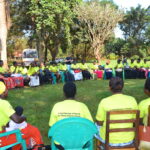
Driven by our interfaith peace building mandate, URI-GL is working with religious leaders to Hold Parliamentary and Local Government Elected Candidates to account on the Electoral Promises made in 2016 in three districts of Uganda, namely Wakiso, Mukono and Kayunga. Cognisant of the complex nature of the political environment, URI-GL is adopting a non confrontational approach where the clergy are making use of their pastoral duty as peace anchors to guide the elected leaders to commit towards the fulfilment of the promises so as to realize effective service delivery and community development.
In her reflection on the driving forces for this initiative, the URI-GL Regional Coordinator says: “The political landscape in our country has been such that a dividing line has been drawn in time in memorial between politicians and religious leaders, with the former enforcing restrictions that deter the latter in what they regard as medaling in politics. Our sanctit conviction could not therefore let us slumber in matters of state welfare; at least the voices from our people at the grassroots would not let us be in comfort”
The project was therefore spot on! It responded to the general outcry from the electorate who have been in dire need of services. Services which have been promised at every election time in vain. The promises have been a norm for every aspiring candidate, who have been smart enough to promise what the people want. They sound quite appealing as this one: “during the 2011 electoral campaigns, a certain candidate promised us better roads and to prove that he was serious about his promise, he hired a number of road construction graders and paraded them at the district headquarters. We hoped in vain without the graders moving an inch to level the road” narrates Senfuma Norman-Mukono district.
This project has really awakened our attention to the issues surrounding us and it is pities that near to majority of our leaders do not even know their roles and mandate. How absurd knowing that we have been so much in slumber with mere learners in the driver’s seat. It is therefore important to engage our Electoral Commission to task any aspiring candidates to provide campaign manifestos during their nominations. Reverend Senkaaga Kizito-Mukono district. Such revelations resonates with why some of the aspiring candidates maybe committed to fulfilling the promises, but lack guidance and constructive follow up to help them deliver on their promises to meet the key needs of the communities.
Following Uganda’s political history therefore, the pilot project took on Wakiso, Mukono and Kayunga districts where political affairs are very heated. The districts are known to have strong contentions between the ruling National Resistance Movement (NRM) and the opposition parties, a huge divide which is quite evident within the electorate. For example, it is common to witness inter and intra party violence among supporters of strong party big-wigs that each of the sides fights tooth and nail to assume or maintain themselves in power. The recent elections have seen a huge rift between supporters of one Aida Nantaba (formerly NRM) against one Karangwa (NRM) over the NRM Chairperson for Kayunga. The divisions are still present until the present day.
Although the project is primarily a follow up initiative on electoral related campaign promises, it is quite inevitable that the religious leaders given their peace building mandate come in handy to address some of the associated differences that emerge from elections. The clergy’s participation in the program has been an eye opener to scale up their role of healing the broken hearts and relations that have been torn during elections. Such are the efforts of spreading messages of unity, tolerance and reconciliation to counter the likely effects of losing an election.
Reflecting back during the project inception, mobilization of the religious leaders was not an easy task. It took a lot of moral persuasion coupled with vivid references to the general community outcry for better services namely; better roads, clean water, better health facilities, rural electrification, tackling the high encroachment on natural resources and so much more. “Going backwards I remember there was a lot of rope pulling to bring the religious leaders on board who were very reluctant and some quite fearful that the state would reprimand them for medaling in politics. Our continued engagement helped them appreciate their pastoral calling to support their flock (the people) to access better services did the magic for us”, reflects Zaria Ddamulira-the URI-GL Legal and Human Rights Officer.
The key pillars and elements in this project lies in creating an open space and free platform for beneficiaries to the services (i.e. the religious leaders) to lead the agenda of holding their own leaders to account on the promises made. With the religious leaders playing a guidance role to help the elected leaders to deliver on their promises, will in the long run ensure that there are no tensions between the leadership and the communities. In this whole process these leaders will get to appreciate their mandate and maybe eventually go back to the drawing board to appreciate what they are able to deliver and not. They will also learn that before they go out to make promises, they can only promise on what their mandate outlines since from our learning, the highest percentage of promises were things that are outside the leaders’ mandate. Lastly, URI-GL yet again prides in her mandate of capitalizing on grassroots resource persons such as religious leaders who are easily identified and respected by the people and with whom the people share a history, needs and aspirations for the future.
The most critical activity during the project inception is the capturing of the electoral related promises which has helped in providing benchmarks for following up on the promises. The process has also yielded far much more than initially anticipated in as far as understanding the dynamics surrounding the electoral campaign process as one Campaign Monitor reflects, “Going to the field we expected that it was going to be a sail through, that candidates would simply make promises for us to record. We were shocked to find most of the campaign rallies turned into musical gallas with mere ululations of the strong candidates. It took us as a team during our periodic feedback sessions with the Secretariat to identify alternative strategies to capture the promises. Eventually we made use of one-on-one interviews, listen-ins on media channels such as TV and radio, and following-up the candidates during their social events such as burials, prayer days and others” Molly Basimaki-URI Campaign Monitor for Wakiso district.
Additionally, we envisage the community dialogues between the elected leaders and the electorate or communities as spearheaded by the religious people being very crucial in the sense that it shall reduce on the tensions between the leaders and the electorate. The most ultimate outcome for the entire process will be the assessment of the leaders through publishing of the performance score card to report back to the electorate on the performance of their leaders towards service delivery.
The pilot initiative is entirely self propelling in as far as yielding self initiatives from the religious leaders to carry forward their work. In most of their feedback, the clergy have embarked on raising awareness among their congregation to take up their constitutional mandate (article 1-power belongs to the people) of demanding services from their leadership. The clergy are already making their task known even among the elected candidates that they are there to guide and support them on fulfilling their promises.
Many lessons can be drawn from this pilot initiative but the most important one is that it helps to understand the quality of leadership we have in our country to assess their commitment towards fulfilling their promises in the realization of service delivery. As they aspire for these positions, do they understand what they are meant to deliver? Are the leaders even aware or do they appreciate that they are accountable to the people? As Uganda and East Africa in general, could it be that the electorate votes for the wrong people or is the electorate simply not empowered enough to vote for the right people? The outcomes of this project will go far in helping us to appreciate whether our leaders are aware that they are accountable to the people who vote them or not thereby informing our next course of action.